
BBC Knowledge idents (1999–2002): launch films, weekday themes, and one loop
This is a motion-branding reading of a short-lived UK channel, written for people who make stings, bumpers, and loops from a logo they already have. MorphLogo is not the BBC, and nothing here speaks for the broadcaster. The diagrams are original schematics. The ident films themselves are not embedded.
A channel in one minute
BBC Knowledge launched on 1 June 1999 and left the air in the early hours of Saturday 2 March 2002. BBC Four took the evening of that Saturday. A contemporary report, cited from the Wikipedia summary of the channel, put the launch budget at about £10 million and the opening day at about six hours. The channel’s job at launch was learning for adults and children, on television and through an interactive pitch that asked viewers to join in.
The junctions changed three times. That sequence is the useful part if you design motion for a mark:
- From June 1999, three named cartoon films, plus a short viewer bumper.
- From 3 April 2000, a documentary and arts turn, with weekday theme films. Magnify stayed on for the slots that did not yet have a theme, including weekends. Its own caption ends in July 2000.
- From the days before Christmas 2000, one looping ident. The theme set was dropped early in 2001. The loop ran on until the closedown.

| When | What the junctions were doing |
|---|---|
| 1 June 1999 | Launch films: Magnify, Propeller, Designer. Share Your Story bumper between programmes. |
| 3 April 2000 | Documentary and arts pivot. History, science, and arts themes on weekdays. Magnify still covers the gaps. |
| Days before Christmas 2000 | One looping ident arrives, beside the theme films. |
| Early 2001 | Theme package withdrawn. The loop remains. |
| Early hours, 2 March 2002 | Final closedown. BBC Four that evening. |
Some later write-ups describe the launch films as cartoon figures climbing between clouds, and the 2001 film as a field of circles. The archive page this article follows does not use that wording. It names the films, the weekday themes, and one loop. Those names and dates are the timeline below. The cloud-and-circle description is only a secondary gloss, so readers of the encyclopedia can see where the two accounts part.
1999–2000: Magnify, Propeller, and Designer
The pre-move idents page labels three cartoon films, left to right, with the spans in the picture captions:
- Magnify, June 1999 to July 2000
- Propeller, June 1999 to April 2000
- Designer, June 1999 to April 2000

They are three separate films, not one master loop with a caption swap. Each carries a different action: a magnifying idea, a spinning propeller, a making-and-drawing idea. The channel mark sits with the word Knowledge. A later visual-identity note credits illustrator Michael Sheehy for the launch films and describes an orange field, white lettering, and a corner bug that began as the channel’s web address before it became the logo. That note is not how the archive idents page is organised. Use it as colour, not as a second timeline.
Between programmes, from June 1999 to April 2000, a bumper led into a short viewer strand called Share Your Story. It is a participation sting, not the station ident. The page shows it going in between almost every programme of that first stretch. If you are mapping a modern package, this is the bumper slot: shorter than the ident, tied to a recurring feature, easy to recognise on a second viewing.
Stills on the same page show three early programmes. Front Room is the interactive strand for adults. K Club is for children. The Kit is about computers and gadgets. They explain the tone of the launch films better than a style name does: bright, hands-on, and aimed at both ages.
The idents page points at the opening-day schedule for context. On the April 2004 capture of that schedule, the link lands on the anchor choice, which is the BBC Choice heading. The Knowledge list is the next block, not its own anchor. It is Tuesday 1 June 1999, and the titles named there include The Knowledge (Jamie Theakston), K Club, Bitesize Etc, Hot Pursuits, Life Stuff, French Fix, and Front Room. The schedule note says the bright lineup gave way to a serious documentary channel before a year was out. The capture does not print clock times for that Tuesday, so this page does not invent any. There is no launch-night article on this site. The schedule itself is the archive copy: Opening Night, captured 9 April 2004.
From 3 April 2000: weekday theme films
On 3 April 2000 the original format was replaced in a single night. The channel turned toward documentary and arts. Weekdays gained theme films. History landed on Mondays, science on Tuesdays, and arts on Fridays. Those three are the first themed set. Captions on those stills run from April 2000 to March 2001.
Business (Wednesdays) and languages, film, and culture (Thursdays) did not get a new film on night one. They kept Magnify. Weekends were not tied to a theme, and they kept Magnify too. The handover was a rollout, not a clean swap of every junction.
Magnify’s own caption runs through July 2000. A business theme is captioned from June 2000 to March 2001, and a film-and-culture theme from July 2000 to March 2001. Those two films closed the remaining weekday gaps, and the page treats that as the point Magnify was dropped altogether, around the middle of 2000. It does not say what weekends used after that drop and before the looping ident arrived just before Christmas 2000.

| Slot | At the 3 April 2000 change | What followed |
|---|---|---|
| Monday | History theme | With the theme package until early 2001 |
| Tuesday | Science theme | With the theme package until early 2001 |
| Wednesday | Magnify, on a business day | Business theme from June 2000 |
| Thursday | Magnify, for languages, film, and culture | Film and culture theme from July 2000 |
| Friday | Arts theme | With the theme package until early 2001 |
| Weekend | Magnify, no day theme | Magnify through July 2000. The page does not name what weekends used after that |
That is a different motion language from the launch films. A theme ident has to read in a few seconds: a subject arrives, then the strand name resolves it. The launch films could be a small story about learning. The theme films have to say which day you are in. Designers still do this when one brand runs several strands and the sting has to signal the strand without a new logo.
A monthly European arthouse film strand, Kino, is reported from April 2000 in the same secondary summary. It matches the documentary-and-arts turn. It is a programme strand, not an ident name on the page we could open.
Christmas 2000 to the 2 March 2002 closedown
In the days before Christmas 2000 the channel added one looping ident. Picture captions date it from December 2000 to March 2002 and show several frames of a single piece. It played in the same junctions as the theme films at first. Early in 2001 the theme package was withdrawn. The one film then carried the channel until the closedown in March 2002.
A loop is the practical form of a station sting. It can sit under a menu, repeat while a junction runs long, and come back as a short return after a trailer. The cost is that Monday no longer looks different from Friday. The theme films had been doing that work. After early 2001 they were gone.
Programme slides were uncommon. When they appeared, they used the same layout as BBC One and BBC Two slides of the time. Trailers followed the generic BBC trailer style. From autumn 2001 the channel name moved to the end of the trailer, with the programme title and the time. An animated “next” caption was built from the ident. The archive page gives those as presentation facts. It does not describe the loop as a circle motif. A Wikipedia visual-identity section does, and it ties a single ident to a 2001 relaunch. Keep that as the encyclopedia’s shape-language. The dates you can check on the open capture are Christmas 2000 for the loop’s arrival, early 2001 for the loss of the theme set, and March 2002 for the end.
Wikipedia, citing the two missing TV & Radio Bits URLs, also says that from 17 November 2001 the schedule was grouped into topic zones and the channel became 24-hour after a multiplex move. The idents capture does not list those zones, and this page will not invent a zone grid. The weekday themes above are ident themes from April 2000, not a November 2001 zone table. What the capture does say about autumn 2001 is the trailer ending: channel name, title, and time together.
The idents page places the final closedown in the early hours of Saturday 2 March 2002, and it presents that closedown as a first: no BBC television channel in the UK had been shut before. BBC Four replaced Knowledge that evening. The opening-night schedule on the same pre-move site also lists BBC Four on Saturday 2 March 2002. A Wikipedia closure sentence dates the replacement to the next day. This article follows the two archive pages that could be opened.
What the motion is doing
Three packages, three jobs:
- Launch films (1999). The action is the brand. Three films mean three ways to say “come and learn,” and a separate Share Your Story bumper for the moment between shows. You maintain a set. Viewers learn more than one picture.
- Theme films (2000). The subject leads, the strand name resolves. Useful when the schedule itself is the message. Slots without a film yet should keep a known ident (here, Magnify) rather than go blank. That is why a relaunch often looks uneven for a few months.
- One loop (Christmas 2000–March 2002). One motion, repeatable. Menus, trailers, and a short return sting can all borrow it. You give up the weekday difference.
A four-beat board for a modern sting uses your own mark. It is not a storyboard of the BBC films.

- Cold open. Motion on an open field. The mark can arrive late. Some logo styles are built to start empty and resolve onto the file you uploaded; small details can shift on those styles.
- Lockup. The logo holds. In the Knowledge trailers after autumn 2001, the channel name did this job at the end, next to a title and a time. Your version is your logo, still, long enough to read.
- Next line. One short line of what is coming, with the mark kept small. Knowledge’s end-of-trailer menu and “next” caption lived here. You write the line. The tool does not supply a programme menu.
- Return. The same loop, shorter, after a clip. This is the beat a single looping ident is good at, and the beat a set of themed films is expensive to maintain.
Nothing in that board asks you to redraw a broadcaster’s artwork. The transferable part is the order: motion, hold, information, return.
A sting from your own logo
MorphLogo starts from a logo file you upload (PNG, SVG, JPG, or WebP). The motion is generated from that file and guided to finish on your mark. It is a tool for your identity, not a library of television idents.
- Logo animation examples shows sting-style motion on marks made for the gallery, so you can judge pacing before you upload yours.
- AI intro video generator is the cold-open beat: a short intro that resolves to your logo.
- Looping logo animation is the Christmas 2000 lesson: one piece that can repeat under a menu or between clips.
- A 3D turn is a different shot from a flat looping package. Use 3D logo animation when the mark should move in space, not when you need a repeatable 2D sting.
Sources and the page we could not retrieve
We did not retrieve this dead link. The Wayback Machine excludes that host. The site’s robots file asked the Internet Archive crawler not to collect it, so there is no public snapshot of that exact URL to quote.
http://www.tvradiobits.co.uk/idents/bbcknowledge.htm
The accessible pre-move source is the same feature on the earlier host, captured 6 May 2004: nascr.net BBC Knowledge idents page. Use that capture as the idents page from before the move to tvradiobits.co.uk. It is not proof that the later file was unchanged. If you carry this further, use public archives and write the capture date next to anything you rely on. A later mirror of the excluded host would be worth saving.
The opening-day schedule linked from that idents page is the 9 April 2004 capture of Opening Night.
Secondary pages, not copies of those files:
- BBC Knowledge for the launch date, the reported budget, the six-hour day, and the November 2001 schedule claim. Its visual-identity wording and its “next day” closure line disagree with the captures above, as this article notes.
- The live TV Ark blurb is a short note. It has carried a 1 January 1999 launch date, which disagrees with 1 June 1999 on the archive idents page and on Wikipedia. This article uses 1 June 1999.
Broadcaster stills and ident recordings stay on those archives. This page does not host them.
FAQ
When did BBC Knowledge launch and when did it close?
It launched on 1 June 1999. The idents page we could open places the final closedown in the early hours of Saturday 2 March 2002, with BBC Four that evening. A Wikipedia summary dates the replacement to the following day. The opening-night schedule captured in April 2004 also lists BBC Four on 2 March 2002.
What were the first BBC Knowledge idents called?
The 6 May 2004 capture names three cartoon films: Magnify (June 1999 to July 2000), Propeller (June 1999 to April 2000), and Designer (June 1999 to April 2000). A Share Your Story bumper ran between programmes across that early stretch.
What changed on 3 April 2000?
The learning lineup was replaced overnight by documentary and arts programming. Weekday theme films began with history on Mondays, science on Tuesdays, and arts on Fridays. Magnify stayed on for business, for languages, film, and culture, and for weekends, until the business film (from June 2000) and the film-and-culture film (from July 2000) closed those weekday gaps. Magnify’s caption ends in July 2000, which is when it was dropped altogether. The page does not say what weekends used after that and before the Christmas loop.
How long did the single looping ident run?
It arrived in the days before Christmas 2000 and played beside the theme films at first. The theme set was dropped early in 2001. The one loop stayed up until the March 2002 closedown.
Table of Contents
Author
More Posts
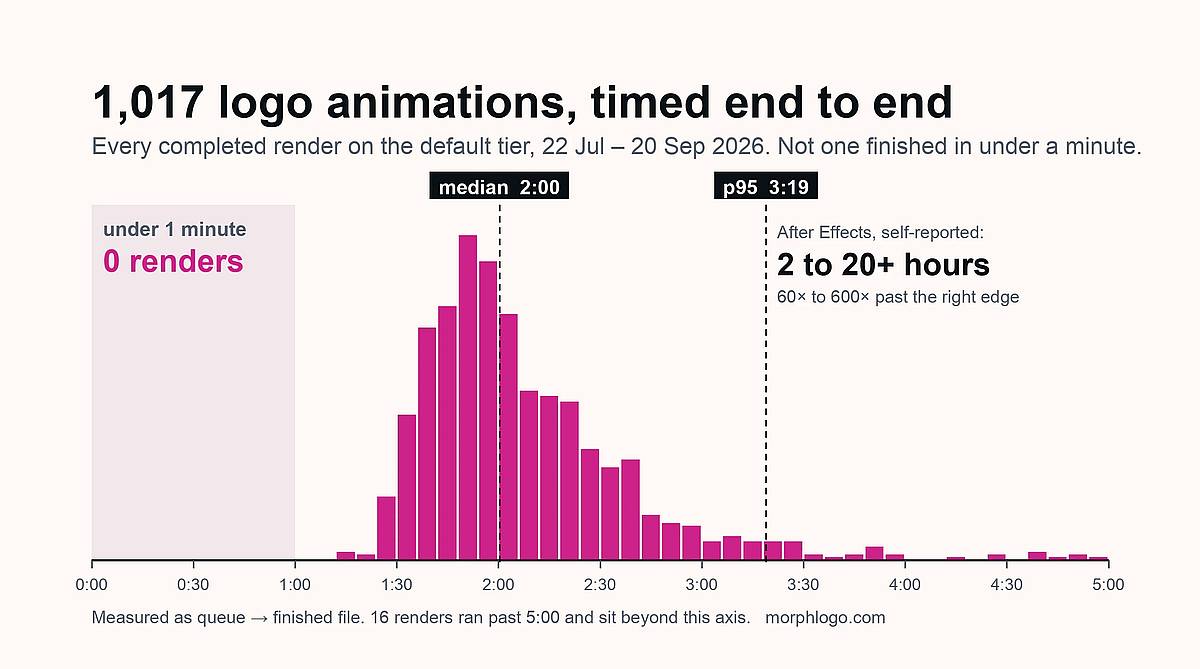
How Long Does It Take to Animate a Logo? Both Routes, Timed
Nobody answers this with a number. Here are both clocks: what working motion designers self-report for an After Effects build, and the full distribution of 1,017 measured AI renders — median 2 minutes, none under one.

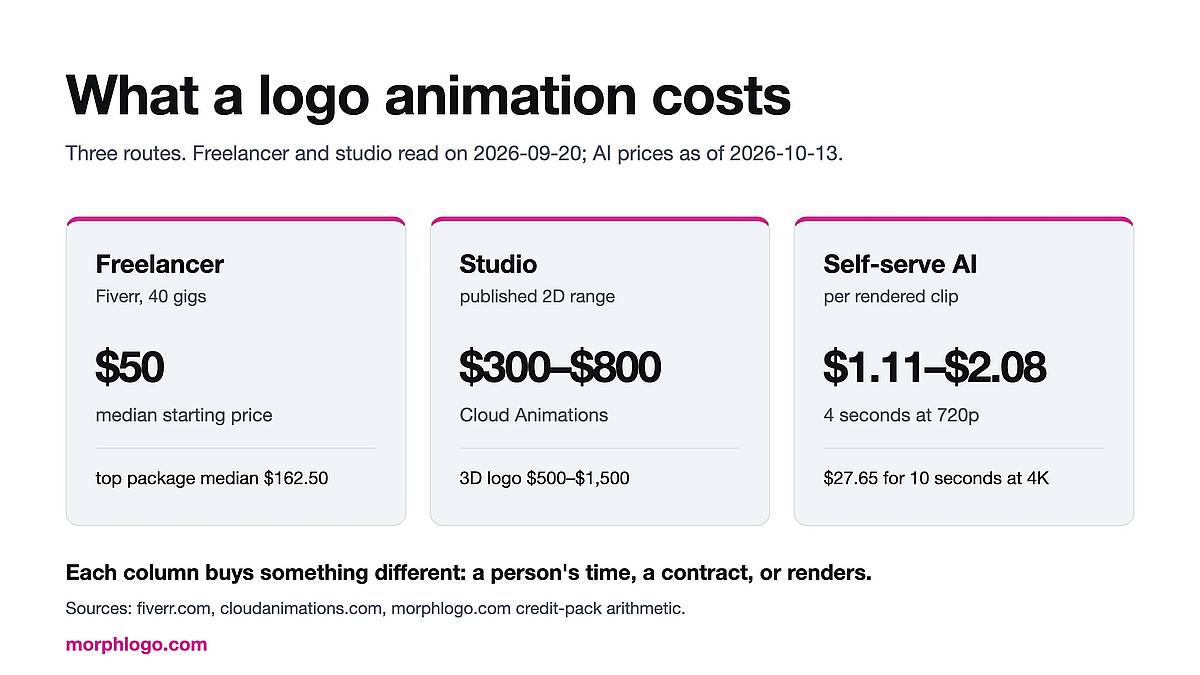
What Logo Animation Costs: Freelancer, Agency or Self-Serve
What a logo animation costs from a freelancer, a studio or a self-serve tool, broken down by deliverable: 40 Fiverr gigs priced on 2026-09-20, the real cost of every add-on, and published studio and day rates.
Animated Logo File Formats: MP4, GIF, WebM or Lottie?
Which animated logo file format to use where: MP4 for video, GIF for email, WebM or WebP for lighter web files, Lottie or SVG for vector UI, with sizes measured on 21 logo renders and a straight answer on transparent backgrounds.